

|
Foreign Language (Spanish) Policy | Link |

|
St Hilda's Modern Foreign Language Curriculum Statement (Spanish)
At St Hilda’s C of E Primary School, we follow the 2014 National Curriculum for Languages and we teach Spanish through the scheme, Primary languages. We are aware that in our school, we have a large percentage of children, for whom English is an additional language and we aim to provide a Curriculum that celebrates a variety of languages and cultures within our community. This curriculum also helps children to develop communication skills such as; speaking, listening, reading and writing.
We have chosen Spanish as the language to be taught at St Hilda’s as Spanish is an international language spoken in a variety of countries and holiday destinations., The British Council have recognised that, Spanish is one of the top 5 languages to learn in the future. Children will become aware that Spanish is spoken not only in Spain, but in many countries across the world. Many children from St Hilda’s will move onto Oldham academy High School in Key Stage 3, Therefore we believe, that we are setting the foundations for future studies whereby children can build on their previously taught knowledge and continue their learning in Key stage 3.
At St Hilda’s in conjunction with the National Curriculum will aim to teach Spanish in order to:
- Listen attentively to spoken language and show an understanding by joining in and responding.
- Explore the patterns and sounds of language through songs and rhymes and link to spelling and sounds and the meaning of words.
- Speak in sentences, using familiar vocabulary, phrases and basic language structures.
- Present ideas and information orally, using a range of audiences.
- Describe people places and things and actions orally and in writing.
- Broaden their vocabulary and develop their ability to understand new words that are introduced into familiar written material, including through using a dictionary,
- Write phrases from memory, and adapt these to create new simple sentences.
Please use this link to view St Hilda's Foreign Language Policy - Spanish.
Intent
At St Hilda’s C of E Primary School, we follow the 2014 National Curriculum for Spanish, which is why we have chosen the scheme, Primary Literacy makes close links to the National Curriculum languages programmes of study. We are aware that in our school, we have a large percentage of children, for whom English is an additional language and we aim to provide a Spanish Curriculum which celebrates a variety of languages and cultural differences within our community. In this way the curriculum will help them develop communication skills such as; Speaking, listening, reading and writing.
We have chosen Spanish as the language to be taught at St Hilda’s as Spanish is an international language spoken in a variety of countries and holiday destinations., The British Councils have recognised that, Spanish is one of the top 5 languages to learn in the future.
The Department for Education announced that, ‘Language skills are important to the social and economic future of the country. Learning a language also helps children and young people, understand the world in which they live and the different cultures of people around the world.’ (Department of Education, 26th August 2010).
Children will become aware that Spanish is spoken not only in Spain, but in many countries across the world. Many children from St Hilda’s will move onto Oldham academy High School in Key Stage 3, Therefore we believe, that we are setting the foundations for future studies whereby children can build on their previously taught knowledge and continue their learning in Key stage 3.
At St Hilda’s in conjunction with the National Curriculum will aim to teach Spanish in order to:
- Listen attentively to spoken language and show an understanding by joining in and responding.
- Explore the patterns and sounds of language through songs and rhymes and link to spelling and sounds and the meaning of words.
- Speak in sentences, using familiar vocabulary, phrases and basic language structures.
- Present ideas and information orally, using a range of audiences.
- Describe people places and things and actions orally and in writing.
- Broaden their vocabulary and develop their ability to understand new words that are introduced into familiar written material, including through using a dictionary,
- Write phrases from memory and adapt these to create new simple sentences.
What a linguist looks like...
- Can understand a range of words and Phrases in Spanish and engage in simple conversations.
- Understand that languages are not only spoken in English but all over the world
- Can write and copy some simple words in Spanish.
- To ask and answer simple questions.
- To use a bi– lingual dictionary to look up unfamiliar words and terms
- To respond to and join in with familiar songs, rhymes and games.
- understand the main points and simple opinion of a longer written passage (e.g. letter, recipe, poem, story, an account.)
- To describe things about my home and school life and express opinions, likes and dislikes.
- Can write a short text attempting to use accurately nouns, adjectives and some commonly used verbs.
Example Knowledge Organiser
Please select the document below.

|
Year 4 Knowledge Organiser Spanish - Jungle Animals | [pdf 129KB] |

|
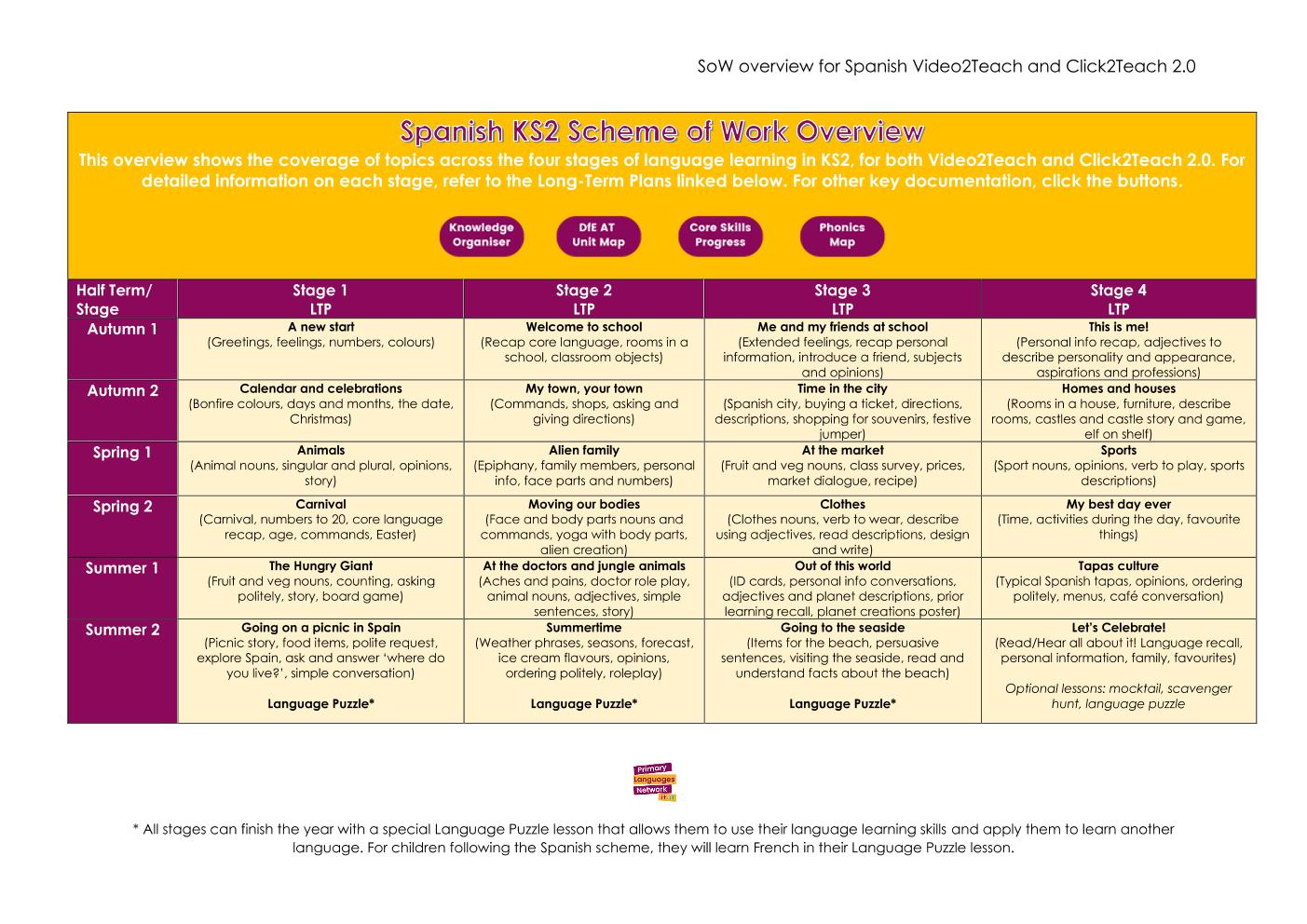
KS2 Spanish Curriculum Map
Please select the document below.
|
|
Whole School Curriculum Map Primary Spanish Year 3-Year 6 | [pdf 144KB] |
|
Implementation
At St Hilda’s C of E Primary School, we have chosen the primary languages scheme which will be accessed online. We have chosen this scheme as it relates closely to National Curriculum objectives and closely based on work and studies by the Department for Education. Children in KS2 will be taught Spanish on a weekly basis for a minimum of 30 minutes. We have chosen to use this scheme as it offers a variety of learning techniques and styles. It also offers non- specialist teaching of Spanish in our school and adapts teaching and learning. All resources contain native speaker audio files in order for children to hear correct pronunciations and terminologies. It offers teachers a ‘click and go’ way of learning and teaching. It is taught through ‘Click to teach or Video to teach’. In this way the children gain knowledge and understanding through a variety of ways. They both offer sheets, codes games and songs as well as many other visual and audio clips. Click to teach is designed for teachers who are more confident in teaching Spanish and offers full lesson plan structures and an in-depth scheme of work. It also provides assessments tools to monitor children’s progress throughout the year, at the end of each half term. The assessment clouds are also used to provide a clear overview of all the learning objects within the scheme of work for each half term. The scheme promotes learning in a variety of ways using language, literacy, reading, writing, action, drama and oral learning of Spanish. It also promotes communication through language which will improve confidence within the classroom. There are teacher tutorials for teachers to access before each session in order to promote the correct delivery and improve confidence in teachers who are less confident.
The scheme also offers opportunities for reception and key stage 1 to access some learning in Spanish to promote progression into key stage 2. Assessment tools are also available and to be carried out each term which assess progression in both reading, speaking, listening and writing.
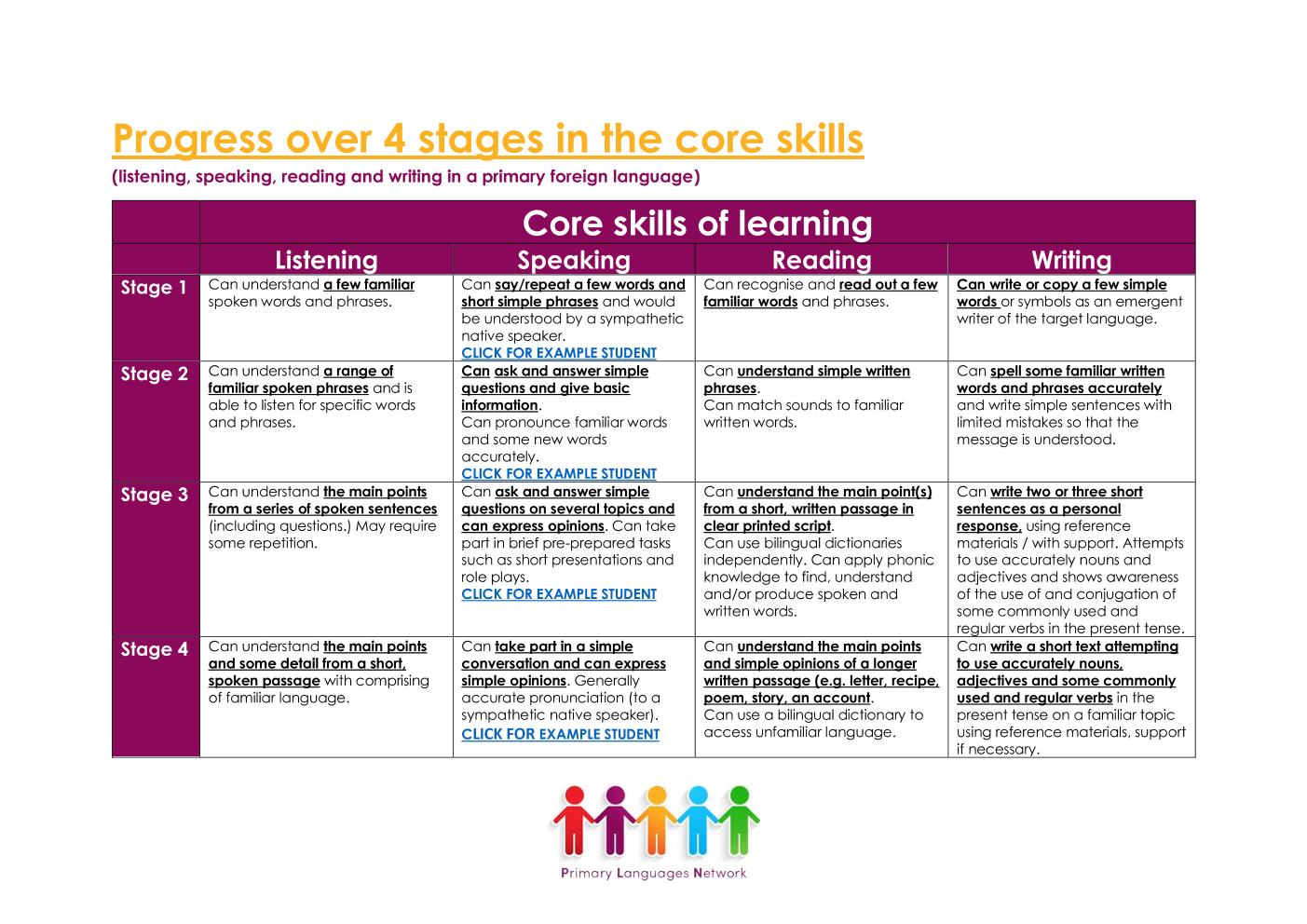
Spanish Progression
Please select the document below.
|
|
MFL - Spanish Progression Map Year 3-Year 6 | [pdf 106KB] |
|
Impact
Spanish will enable resilience in making errors and responding repeating and improving through memorising words and phrases. It will also promote diversity in understanding the importance of the diversity in language and how it is used in other countries across the globe. The learning of a language will provide a medium for cross- curricular links and reinforce knowledge and understanding in other subjects. It will offer them an awareness of multilingual and the multicultural world and community that surrounds them and give them insight into other cultures as well celebrating their own.
Send children will be learning at the same pace as their peers but will be offered additional. support where needed. Using a multi- sensory and kinaesthetic approach offered in the scheme of work, will provide additional support for those who may learn in different ways.
Spanish Curriculum in Pictures
Please click on the picture link to see how the curriculum is taught at St Hilda's School.


National Curriculum - Modern Foreign Language
 |
KS2 Modern Foreign Language Curriculum |
