
English as an Additional Language (EAL) refers to any student learning and using English as an additional or second language.
‘A pupil’s first language is any language other than English that a child was exposed to during early development and continues to be exposed to in the home or community.’
If a child has been exposed to a language other than English, it is important for us to know, regardless of how well they now speak English.
EAL learners are a diverse group and there is a range of definitions for an EAL pupil:
- children who are growing up in bilingual families (having two languages spoke at home)
- children who have lived in UK a long time, or were born in the UK, but speak one language at home and another in school
- children who began life in another country, where another language was spoken, and who now live in the UK
We recognise that a pupil's ability to thrive is linked to an inclusive environment where they feel valued and confident. As with other groups of learners, our teachers adapt their lessons to make sure that all learners can access the learning provided. They do this by involving learners in activities where the language is challenging but appropriate to their abilities and interests.
English as an Additional Language (EAL) at St Hilda's School
We understand that our pupils are all learning English at different stages and this is reflected in the adaptations and inclusive practices that underpin our approach to teaching and learning. We use effective systems to assess and develop pupils' proficiency in English alongside classroom practices informed by high-quality research.
We want all of our pupils to achieve fluency in English – both at a social and an academic level and we value the extent that families contribute to this.
Our EAL team works to support pupils at every stage of their academic journey. This support structure includes, but is not limited to:
- Supporting pupils as they settle into our school.
- Focused teaching and interventions to ensure pupils have the opportunity to learn and develop their language skills with the support of expert staff.
- Inclusive classroom environments that provide good language role models, immersion in English and the opportunity to learn in a language-rich setting.
- Support from peers to ensure pupils feel included, valued and celebrated as a member of our school community.
- Training for staff to ensure they feel equipped and empowered to support pupils in their English learning experience.
There are lots of valuable online resources that can help support learning English as an additional language, but we also recognise and value the contributions families can make to developing pupils' skills in home languages. A strong knowledge of the home language is absolutely crucial in developing pupils' sense of their identity and accelerates their progress in learning English.
How can teachers best meet the needs of EAL learners?
Certain principles help teachers adapt their lessons to the needs of EAL learners. By following these, teachers can help these children reach their educational goals and play a positive part in our school life, the community and society as a whole.
The potential among EAL learners for bilingualism is particularly important, as it increases mental ability such as problem-solving and creativity. Bilingualism gives EAL learners a fantastic advantage when looking for a job later on, too. Our teachers therefore consider the role of learners’ first language and be aware that the acquisition of a new language goes hand-in-hand with cognitive and academic development.
Here are some of the ways our teachers ensure EAL learners can access the curriculum and reach their full potential:
- Collaborative group work
- Enhanced opportunities for speaking and listening
- Effective role models of speaking, reading and writing
- English speaking talk partners to help develop vocabulary
- Alternative phrasing of instructions and objectives
- Additional visual support, e.g. posters, objects, non-verbal clues, pictures, demonstration, use of gesture, etc.
- Bilingual resources where needed, e.g. dictionaries, on-line support, texts, key word lists
- Writing frames, directed activities related to texts
- Opportunities for role play
- Regular opportunities for feedback from staff
- Learning progression moves from concrete to abstract
- Further support for pupils’ language development is also provided outside the formal curriculum, e.g. in assemblies, school clubs, homework clubs, etc.
Teaching Strategies
- help the child to learn some useful phrases (Where is… What’s that?.. I want..) and the routines of the classroom so they can communicate with the peer group
- use circle time to model responses
- provide lots of books in various languages including the pupil’s home language
- use the home corner to reflect aspects of the pupil’s culture and to provide objects and toys to familiarise the pupil with the new local culture
- talk with the other pupils about the different languages spoken
- invite speakers of the pupil’s language and others to come in for story telling activities
- learn some words in the pupil’s language, including the basics such as yes, no, thank you, hello, goodbye, numbers and colours
- use dual language texts and if possible, taped stories in English and the learner's language (older bilingual pupils in the school or adults may be able to help record stories)
- plan pair and group activities inclusive of the new learner and proficient monolingual English-speaking pupils
- use lots of photographs and provide visual aids through story props, magnetic cut outs, puppets, masks and dressing up clothes (including positive images that reflect the new pupil’s background) to stimulate talk and promote vocabulary development
- provide dual language or multilingual signs around the nursery or classroom
- provide lots of ‘hands-on’ experience, so the children can learn the new language through participating in activities that support their cognitive development
- use small group activities as a basis of one-to-one talk with the child so that you have something stimulating and meaningful to talk about
- think-aloud’, that is, talk through your actions and use gestures as you introduce and participate in a new activity
- ensure that adults use a variety of question styles to encourage the pupil to use a variety of language functions
- allow at least 10 seconds of ‘think time’ for children when they are asked to answer a question
- accept that there may be a period of non-verbal communication on the part of the pupil; the pupil will be observing, listening and learning during this silent period time
- use a home-school book to communicate with parents
- invite parents into the classroom to read to their child in their first language
Learners of EAL and the Silent Period
Many children whose first language is not English go through a “silent period” when they first come into school in this country. This may last for several months but eventually these children do begin to speak at school. Priscilla Clarke’s strategies listed below offer advice on ways to help children through the silent period:
- continue talking even when children do not respond
- persistent inclusion in small groups with other children
- use of varied questions
- inclusion of other children as the focus in the conversation (pair the learner with a buddy and ask questions of both children)
- use the first language
- accept non-verbal responses
- praise even minimal efforts
- continue to expect that the child will respond
- structure lessons to encourage child-to-child interaction
- provide activities which reinforce language practice through role play
- remember this is not a passive stage: all the time they are in their silent period, children are taking in everything that is going on around them, including the new language

Guidance, Advice and Support
Download these short, easy to understand guides for parents of students who use English as an Additional Language (EAL) on how to get involved in school life and help their child to learn. The guides are available in the 22 most commonly used first languages in UK schools.
 |
EAL Parents Guidance: Helping Children Learn |
|
Guidance for parents of students who use EAL: About the English education system |
|
The Bell Foundation EAL Resource Library |
|
Teaching Resources |
| The Bell Foundation offers a range of free resources to support EAL teaching and development within schools. | |
|
Guidance Resources |
EAL Research and Recommendations
In this summary, we outline our policy recommendations, across five key areas, for ensuring that pupils who use English as an Additional Language (EAL) receive effective and appropriate support in education:
- Policy informed by appropriate data;
- Reintroduction of statutory proficiency assessment;
- Appropriate EAL allocation within the National Funding Formula;
- Build EAL expertise into statutory teacher training curriculums;
- Don’t leave behind children arriving late into the school system.
For more information on the educational outcomes of EAL pupils please see the document below.
|
Policy Recommendations Summary |

EAL Assessment Framework - Primary
This resource includes links to the Foundation's award-winning EAL Assessment Framework for Schools, Support Strategies and digital EAL Assessment Tracker for use in primary settings
On this page you will find links to The Bell Foundation’s award-winning EAL Assessment Framework for Schools, Support Strategies and digital EAL Assessment Tracker for use in primary settings. Also on this page are videos which provide guidance on how to use these resources.
|
EAL Assessment Framework - Primary Schools |
BBC Tiny Happy People
Will hearing me speak more than one language confuse my child? Is the speech of bilingual children delayed? We've got the answers and information on the benefits of bilingualism.
|
BBC Tiny Happy People - Bilingual |
Bringing up Your Child Bilingual
Advice an guidance leaflets in different languages.
|
Bringing up Your Child Bilingual - English |
|
Bringing up Your Child Bilingual - Polish |
|
Bringing up Your Child Bilingual - Russian |
|
Bringing up your Child Bilingual - Romanian |
All About School

|
Subjects I Will Learn at School | [pdf 1MB] |

|
|
|
What we do at School | [pdf 2MB] |
|
|
|
What is in a Classroom | [pdf 2MB] |
|
|
|
School Furniture in the Classroom | [pdf 889KB] |
|
|
|
How we Learn at School | [pdf 755KB] |
|

Department for Education English as an additional language (EAL)
Learn how to support multi-lingual children and make learning opportunities that are not dependent on the child’s English ability.
|
DfE English as an additional language (EAL) |

Early Years: Supporting Children Learning English as an Additional Language
|
EYFS - Supporting Children Learning English as an Additional Language |

Understanding the Steps of Learning for Children with EAL in Early Years
Please select the document below.
|
|
Understanding the Steps of Learning for Children with EAL in the Early Years | [pdf 4MB] |
|

Understanding the Stages of Learning for Children with EAL
Please select the document below.
|
|
Understanding the Stages of Learning for Children with EAL | [pdf 357KB] |
|

EAL Children First
English as an additional language learners will have differing educational experiences and may be:
- newly arrived in the country
- refugees, asylum seekers or economic migrants
- from established ethnic communities born in the UK
The English as an Additional Language Team can provide advice, guidance and resources to support schools and settings to build their capacity to meet the needs of this vulnerable group.
With our support you can develop your inclusive practice in order to welcome and celebrate the cultural diversity of your school community and ensure that your English as an additional language learners access an appropriate curriculum and make progress.
|
EAL - Children First |
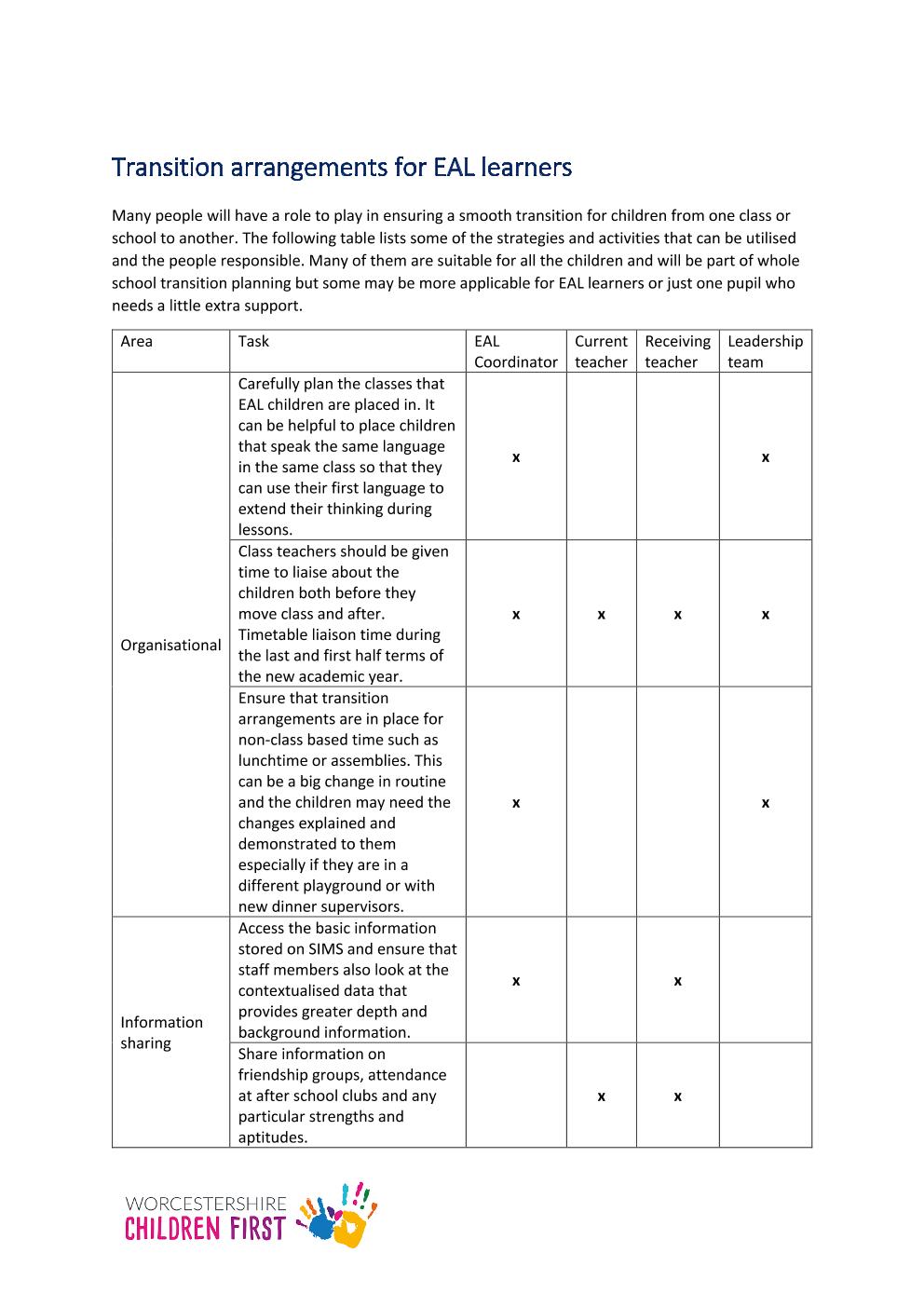
Transition Arrangement for EAL Learners
Please see the document below.
|
|
Transition Arrangements for EAL Learners | [pdf 133KB] |
|
Supporting Languages and Culture
These guides are for parents/carers to help them understand and be able to use the same strategies at home as teachers use in schools.

Childnet
Information and advice for parents and carers on supporting young people online. Information and advice from childnet for parents and carers on keeping young people safe online in the following languages: English, Arabic, Bengali, Hindi, Polish, Punjabi, Somali, Spanish, Turkish, Urdu, Vietnamese and Welsh etc.
|
Parents: Supporting Young People Online (Leaflets) |

British Council
Our teachers, classrooms and courses encourage children to experiment with language, build confidence and improve their communication skills in a safe, supportive and stimulating environment.
|
British Council for Teens and Kids |
|
Learning Time With Timmy |
| The British Council and Academy Award®-winning Aardman animation studios bring you Learning Time with Timmy. This innovative learning experience includes courses, apps and a video series to help children aged two to six learn English. | |
|
Learn English Kids |
| LearnEnglish Kids is brought to you by the British Council, the world's English teaching experts. We have lots of free online games, songs, stories and activities for children. For parents, we have articles on supporting children in learning English, videos on using English at home and information about English courses for your child. | |
|
Learn English Parents |
| In this section you'll find lots of expert advice about helping your child learn English. You can search our hundreds of free online English games, songs, stories and activities here and find more information on our apps for mobile phones and tablets. |

Useful EAL Websites
|
EAL Highland |
| has many resources in different languages including key vocabulary with translations and introduction to school booklets; it also has links to many other resource areas. | |
|
NALDIC - The National Subject Association for English as an Additional Language |
| you have to join the organisation, but it is well worth it. |

Bilingual Books
|
Mantra Lingua UK |
| contains lots of useful resources to buy including the Talking Pen! Bilingual books and charts, Key Stage 3 and Key Stage 4 resources, vocabulary for maths, science and English lessons; worth a look if you have a budget for learners. | |
|
World Stories |
| has a range of texts that the pupil can read or have read to them in English or a selection of other languages; there are also activities and tracking tools available for classes or individual students. | |
|
International Children's Digital Library |
|
Bilinguis |
| Welcome to bilinguis.com, your source for side-by-side books. We believe that reading bilingual books and inferring the vocabulary and grammar is a far superior method of language learning than traditional memorization. |
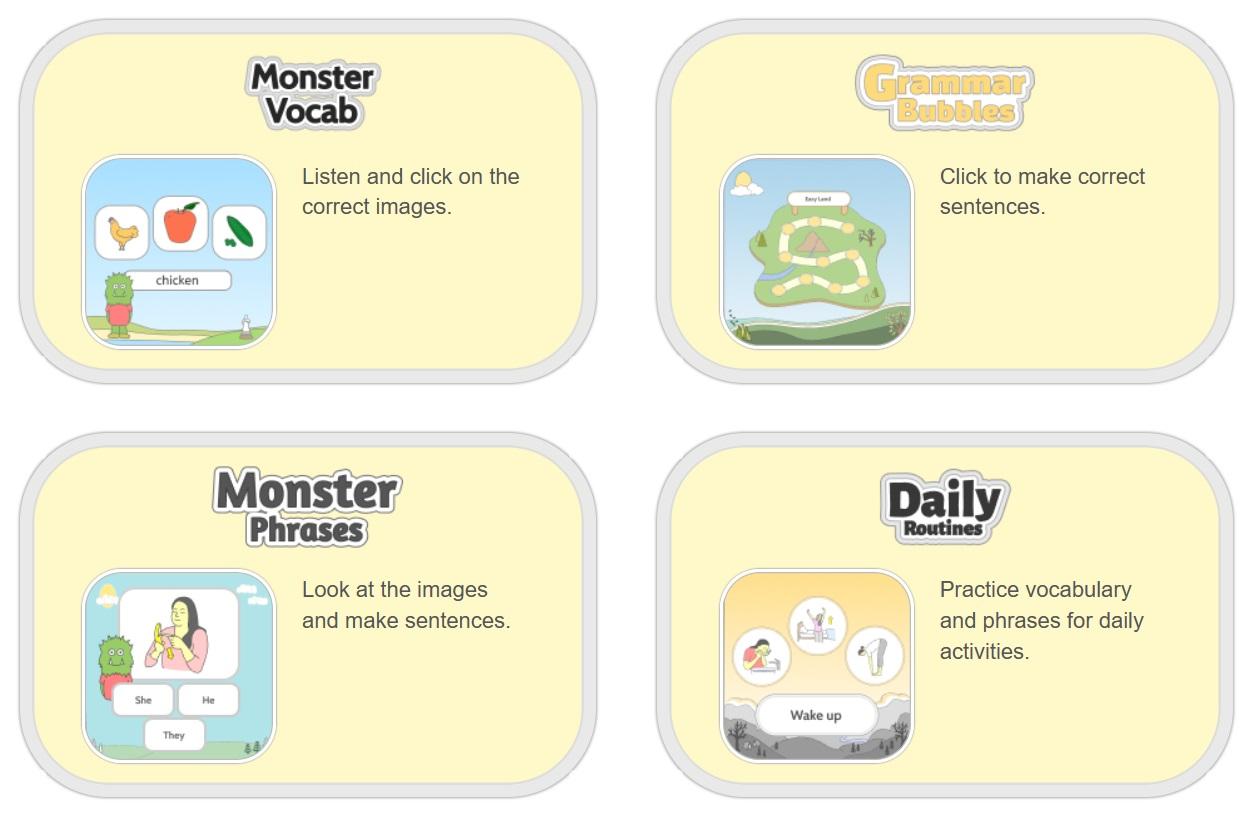
Games to Learn English
Please use the links below.
|
Games to Learn English |
|
Duolingo |
| Duolingo is a language learning app, that can be downloaded for free via the App Store or Google Play. It is designed as a game, to make learning fun, and is accessible to all. | |
|
BBC Learn English |
| Watch these videos and learn some English words and phrases to help you with everyday life |