
Over the course of their education, children spend over 7,800 hours at school. With such a huge amount of time spent in the classroom, schools provide an ideal environment for promoting good emotional wellbeing and identifying early behaviour changes and signs of mental distress. The social and emotional skills, knowledge and behaviours that young people learn in the classroom can help them to build resilience and set the pattern for how they will manage their mental health throughout their lives. Emotional wellbeing is a clear indicator of academic achievement, success and satisfaction in later life. Evidence shows that mental health and wellbeing programmes in schools, can lead to significant improvements in children’s mental health, and social and emotional skills. Wellbeing provision in schools can also lead to reductions in classroom misbehaviour and bullying.

Mental Health and Wellbeing Parent Resources
As part of our Useful Information Directory we have a section with Mental Health and Wellbeing Resources. Please use the link to access these.
 |
Mental Health and Wellbeing Resources for Parents |
Jigsaw - St Hilda's PSHE Scheme of Work
Jigsaw, the mindful approach to PSHE, brings together Personal, Social, Health Education, emotional literacy, social skills and spiritual development in a comprehensive scheme of learning. A lesson a week with the teaching resources included, helps teachers to focus on tailoring the lessons to their children’s needs and to enjoy building the relationship with their class, getting to know them better as unique human beings.
Teaching strategies are varied and are mindful of preferred learning styles and the need for differentiation. Jigsaw is designed as a whole school approach, with all year groups working on the same theme (Puzzle) at the same time. This enables each Puzzle to start with an introductory assembly, generating a whole school focus for adults and children alike.
The curriculum is delivered through the following six themes, which change every half-term: Being Me in My World; Celebrating Difference, Dreams and Goals; Healthy Me; Relationships and Changing Me.
Wellbeing put into Practice
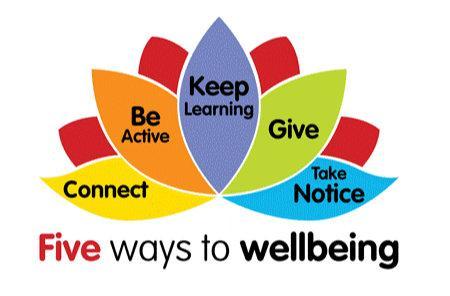
Putting the five ways to wellbeing into practice is easy - and you may already be doing these without even knowing it.
1. Connecting
Take time to talk about feelings and listen
Share mealtimes to talk about their day
Find activities you can enjoy together as a family
Encourage them to see their friends outside of school rather than by phone or online
2. Be Active
Go for a walk, run, skip, cycle, swim, dance - whatever they may enjoy, indoors or outdoors
Find a local group sport or activity they can join
Exercise is a mood booster and a great way to feel good
3. Take Notice
Take them out to a park, woods, the seaside or even a different part of the town so they can enjoy a varied environment
Encourage them to notice how they are feeling and how they can process their emotions in a positive way
4. Keep Learning
Learning isn't just for school. Encourage them to read 'just for fun'
Pass on skills like cooking, sewing, model making, photography and DIY so they know that learning can be fun
5. Give
Help them to be kind, share and show interest in others
Encourage them to do something nice for a friend, family member or charity

Mental Health and Wellbeing School Learning Zone
The last year has been extra stressful, especially if you’re a parent. It's normal and entirely understandable if you're feeling overwhelmed frustrated, worried or exhausted about the situation.
You might be finding it harder than ever at the moment to know how to best look after your child’s mental health and wellbeing, as well as your own. If you’re struggling, you are not alone. Here are some resources that can really help. Please click on the picture link to access the resources.
Eight principles to promote emotional health and wellbeing in schools
Each principles has a set of evidence based interventions with objectives and outcomes to deliver the principle.
- Leadership and management - That supports and champions efforts to promote emotional health and wellbeing.
- Ethos and environment - that promotes respect and values diversity.
- Curriculum teaching and learning - to promote resilience and support social and emotional learning.
- Targeted support - and appropriate referral.
- Working with parents/ carers.
- Identifying need and monitoring impact of interventions.
- Staff development - to support their own wellbeing and that of students.
- Enabling student voice to influence decisions.

|
Wellbeing Whole School Approach | [pdf 753KB] |

|