
Writing Intent
At St Hilda’s CE Primary School, we aim to develop confident, articulate writers who express themselves with clarity, creativity, and purpose. Through a structured and inclusive approach, pupils build strong transcription skills, grammar, punctuation, and the foundations of effective composition, enabling them to communicate successfully across different contexts and audiences.
We use high-quality, diverse texts across the curriculum to inspire writing, broaden vocabulary, and explore different voices, cultures, and experiences. Linking texts to wider curriculum themes provides meaningful, real-world contexts that enrich learning and deepen understanding.
Bespoke Writing Curriculum
At St Hilda’s CE Primary School, we have developed a writing curriculum rooted in the National Curriculum and tailored to our school context. Sequenced from the Early Years to Year 6, it supports progression, reflects our diverse community, and broadens pupils’ cultural capital to develop confident, capable writers.
Our long-term plans build on prior knowledge and systematically develop skills in transcription, composition, punctuation, grammar, and vocabulary. Guided by the Writing Framework 2025, we emphasise oral rehearsal, sentence construction, cohesive paragraphing, and regular revising and editing. This ensures all our Apprentice Word Wizards become fluent writers, able to communicate effectively for a range of purposes and audiences.

|
Year 6 Writing Long Term Plan | [pdf 254KB] |

|
The table below demonstrates our comprehensive approach to writing, ensuring all foundational elements are in place for pupils to achieve writing proficiency.
|
Class texts are used to inspire purposeful writing for a range of audiences. |
|||||||
|
Transcription |
Composition and Effect |
||||||
|
Spelling |
Handwriting |
Oracy & drama |
Vocabulary |
Punctuation |
Grammar |
Modelled and shared writing |
The writing process |
Spelling
In EYFS and Key Stage 1, spelling is taught through the Supersonic Phonic Friends programme, providing a strong foundation in phonics, early spelling skills, and common exception words. Fully aligned with the National Curriculum, it ensures consistent progression from the earliest stages. In Key Stage 2, instruction builds on this foundation with a focus on spelling rules, patterns, strategies, and statutory word lists. Age-appropriate spellings are curated in the Book of Spells, with regular opportunities to revisit prior learning and celebrate achievement through annual Spelling Bee competitions.
|
|
Year 4 Spelling Overview | [pdf 84KB] |
|
Handwriting
Handwriting is introduced from EYFS using the Letter-join scheme, emphasising correct letter formation and fluent, legible writing. High standards of presentation are celebrated across all stages. Pupils in Years 1–3 earn a special pencil for neat writing, while those in Years 4–6 who demonstrate elegant cursive receive a pen licence and join the Word Wizards’ Handwriting Guild, a community of young scribes proud of their craft.
|
|
Year 3 Handwriting Long Term Plan | [pdf 215KB] |
|
Oracy
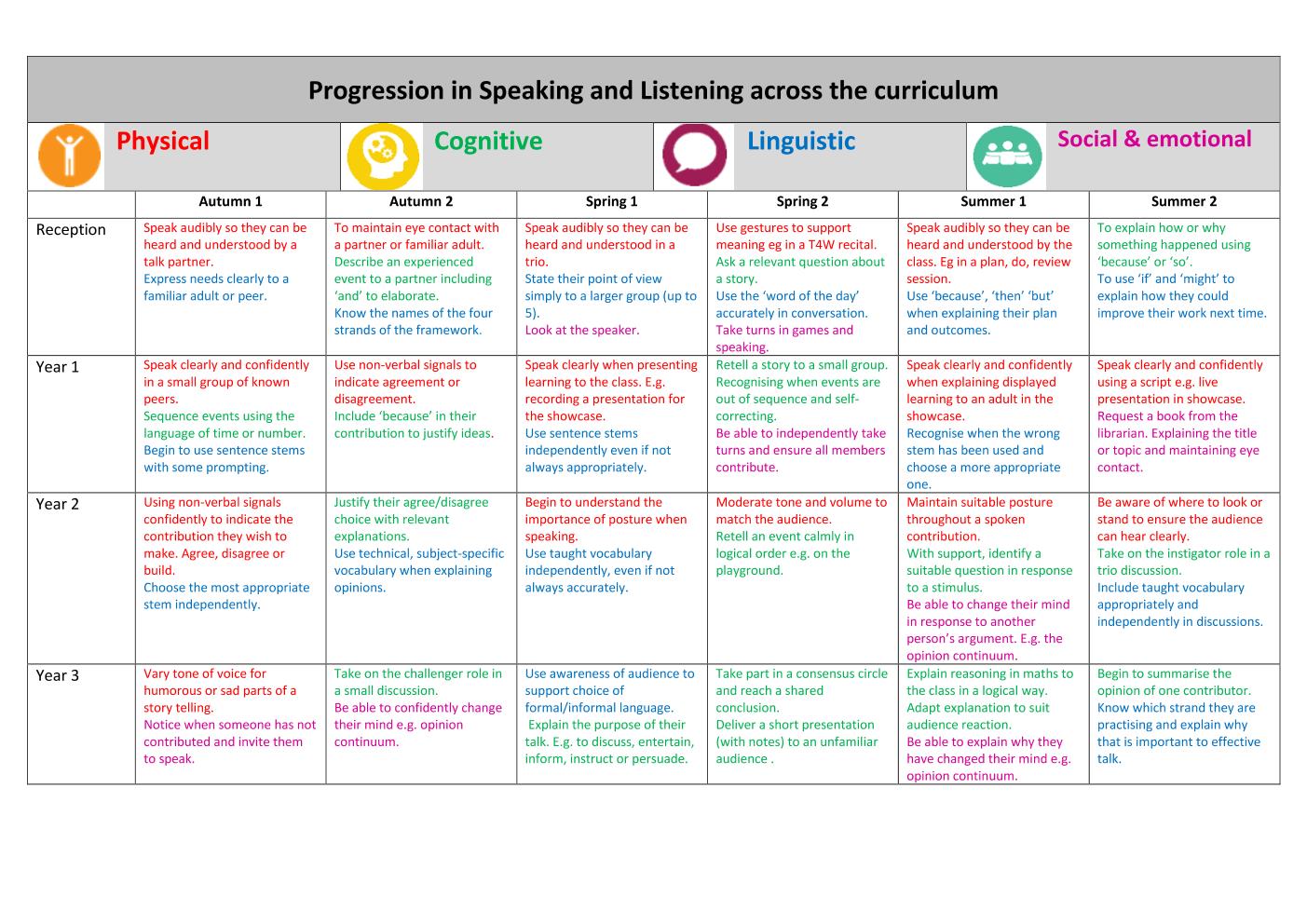
Oracy is central to ensuring pupils become confident, articulate communicators. Staff model Standard English and provide planned opportunities for pupils to speak for different purposes and audiences, exploring ideas, building arguments, and expressing themselves in full sentences. Classroom talk is structured through Super Speaking and Super Listening expectations, and guided discussion is supported by Discussion Guidelines, creating a safe environment for constructive debate. The Oracy Framework from the University of Cambridge and Voice 21 underpins this approach, developing pupils across four strands—physical, cognitive, linguistic, and social & emotional—so they can speak clearly, think critically, and participate confidently in discussion.
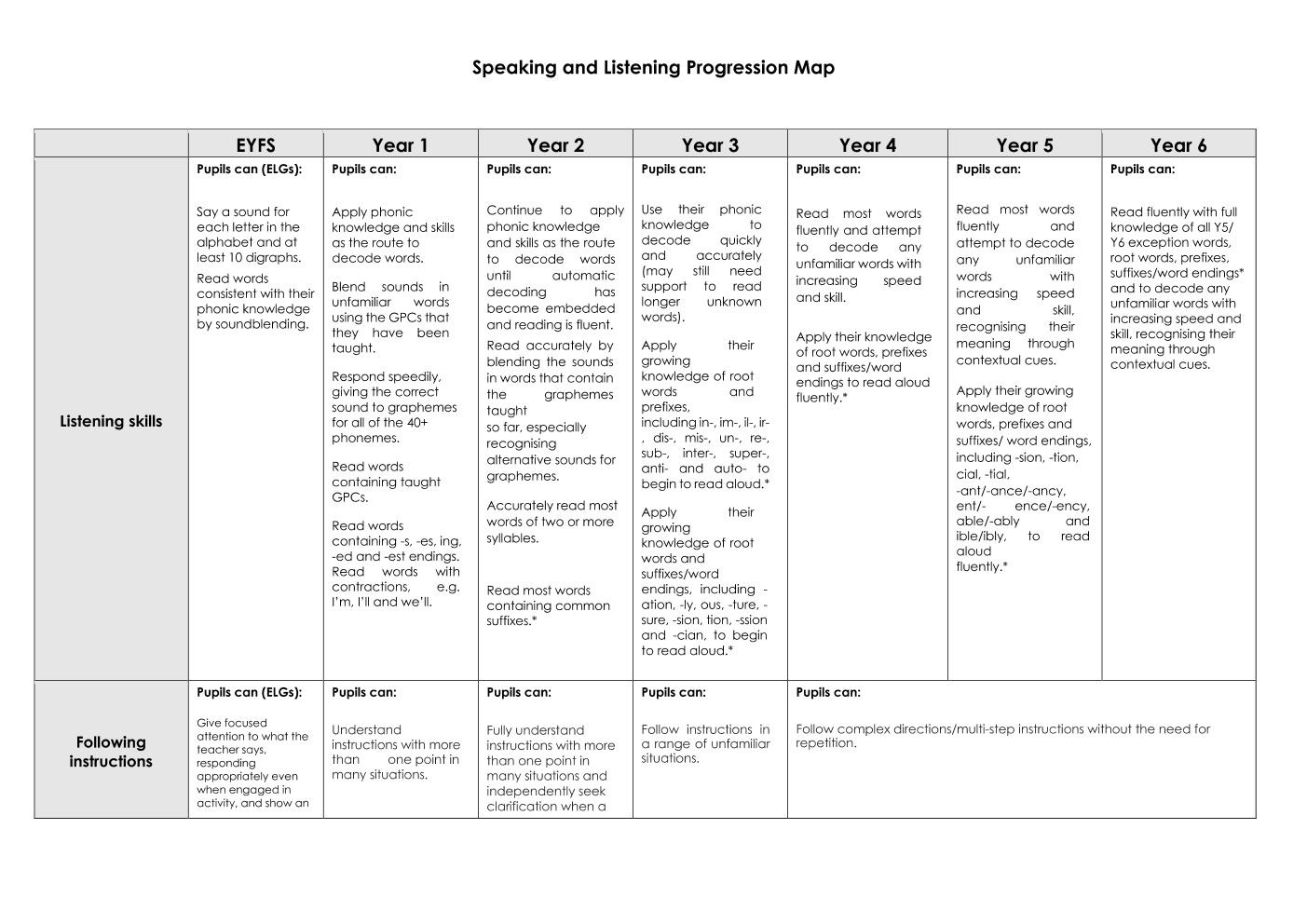
Progression of Speaking and Listening Across the Curriculum
Vocabulary
Vocabulary development follows a three-tiered approach. Basic, high-frequency Tier 1 words are reinforced naturally in everyday language. Tier 2 words, which are age-appropriate and more challenging, are explicitly taught and recorded in the Book of Enchantments, with repeated opportunities to encounter and use them in context. The Word Aware STAR approach—Select, Teach, Activate, Review—ensures mastery, enabling pupils to read, write, and use these words confidently. Tier 3 subject-specific vocabulary is highlighted in classrooms and English lessons to support understanding and long-term retention
Punctuation and Grammar
Punctuation and grammar are taught through a progressive, cumulative sequence, allowing pupils to revisit and build on prior learning. Concepts are introduced in line with writing development and reinforced through practical application in a range of writing tasks. In Key Stage 2, daily grammar starters consolidate skills, and by Years 5 and 6, pupils can apply punctuation and grammar confidently to enhance clarity, meaning, and style, becoming expressive and capable writers.
|
|
Year 5 Vocabulary, Punctuation, Grammar and Composition | [pdf 57KB] |
|
The Writing Process
At St Hilda’s, we aim to prepare children for writing by helping them internalise the content, purpose, and language of what they will write about. Each writing unit typically lasts 2 to 3 weeks and is based on a carefully selected class text, which serves as a central stimulus for the unit. The writing process follows these key stages:
In Preparation for Writing
|
Hook |
Immersion |
Analyse |
Organisational Features/ Grammar and Punctuation |
Word choice |
Generate Ideas /Model writing |
|
The class text serves as the principal stimulus for writing and may lend itself to an experiential activity. |
Foster a deep understanding of the text (historical, cultural, social context, themes, characters etc.) |
Analyse a WAGOLL to identify key genre features and develop an understanding of the text type, the audience and the purpose. |
Explore the structure and layout of the genre. Explicit grammar and punctuation instruction. |
Explore and apply language techniques and carefully chosen vocabulary suited to enhance the impact, style, and clarity of their writing. |
Brainstorm, discuss, research, oral rehearsal etc (essential for encouraging engagement). Teachers to model writing if needed. |
The Writing Process
|
Plan |
Draft |
Revise |
Edit |
Publish |
Share |
|
Generate ideas, structuring content, and considering audience and purpose |
Write the initial version |
Refine vocabulary, sentence structure, and overall clarity |
Provide verbal feedback, ensuring technical accuracy |
Produce a polished version using their best handwriting |
Present and celebrate writing to an audience |