

|
Geography Policy | Link |

|
St Hilda's Geography Curriculum Statement
At St Hilda’s C of E Primary School, we follow the 2014 National Curriculum for geography and the Early Years and Foundation Stage Framework to ensure that all children:
- Gain a coherent knowledge and understanding of Britain’s physical and human geography and that of the wider world which helps to stimulate their curiosity to know more about our planet.
- Learn to ask perceptive questions, think critically, weigh evidence, sift arguments, and develop perspective and judgement.
- Begin to understand about the relationship between places and people, resources in the environment, physical and human processes and the formation and use of landscapes.
What a Geographer looks like...
- To have a good understanding of their heritage country.
- To be able to understand images and perspective.
- To know and understand where they live in Oldham.
- To interact with the world around them.
- To be able to read a map.
- To have a broad range of technical vocabulary.
- To have a good understanding of scale.
Implementation - Sequence of Learning and Big Questions
These skills are embedded within geography lessons and developed throughout the children's journey through the geography curriculum. By the end of their primary education, children will have the foundation of a secure understanding of British human and physical geography. The study of important parts of world geography runs in parallel with this. They should be able to draw comparisons and make connections between different parts of Britain and the world and their own lives.
The content and principles underpinning the geography curriculum are taken from the 2014 National Curriculum, for Key Stages one and two and the EYFS Framework, for the Foundation Stage. Cross curricular work is planned when appropriate.
Teachers are actively encouraged to look elsewhere for additional material including on-line resources, to complement and expand the above. Trips and visiting experts are used to enhance learning. We also encourage project and enquiry based approaches to learning with an emphasis on people and community in our local area.
Teachers, in parallel classes, plan together to create engaging and informative teaching and learning opportunities which take into account prior learning, planning opportunities for assessment and identifying suitable future targets.
Progression in geography will be assessed through listening to children’s responses and contributions to discussions and evaluating their written work. An age-related assessment will be given to parents/carers in reports.
Geography Whole School Overview
Please select the document below.

|
Geography Whole School Overview | [pdf 90KB] |

|


History and Geography Two Year Cycle 2024-25
Please select the document below.
|
|
History and Geography Two Year Cycle 2024-25 | [pdf 116KB] |
|
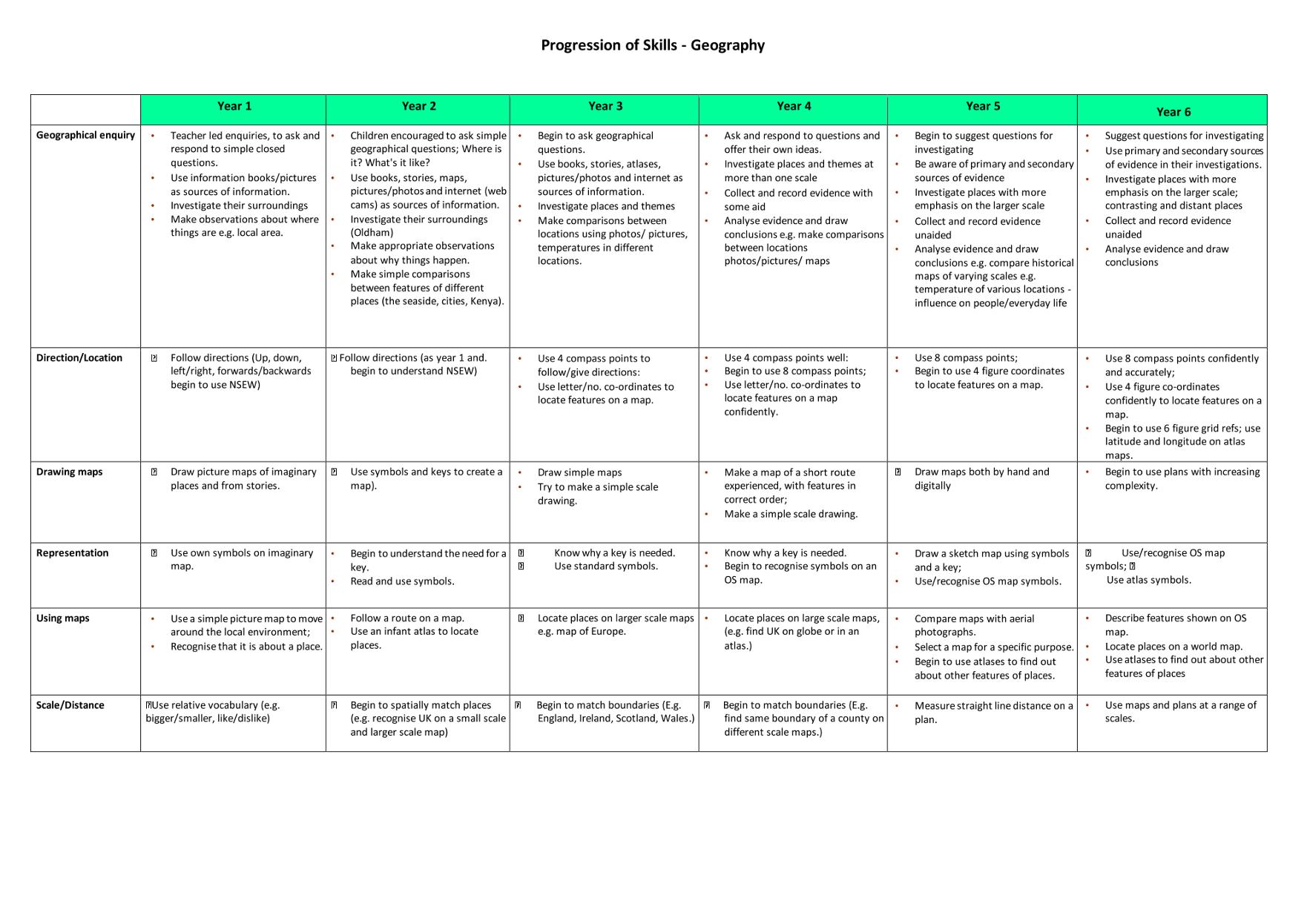
Progression of Skills
Please select the document below.
|
|
Geography Progression of Skills | [pdf 155KB] |
|
Geographical Enquiry PDM
Please select the document below.
|
|
Geographical Enquiry PDM 2026 | [pdf 1MB] |
|
Impact
All children are given the opportunity to attain age related expectations in geography by the end of Year 6, so that children can reach and exceed their potential in geography.
As geographers, children will gain a broad understanding of peoples and places to influence the decisions they make in their future lives.
Equality Impact Assessment
By the end of each key stage, pupils are expected to know, apply and understand the matters, skills and processes specified in the relevant programme of study. monitoring and evaluation
We ensure equality and diversity is embedded in all areas of the curriculum.
Geography Curriculum in Pictures
Please click on the picture link to see how the curriculum is taught at St Hilda's School.

Year 1 Topic - Why is Weather different around the World?
Please select from the documents below.
|
|
Year 1 and 2 Geography Knowledge Organsier - Why is the weather different around the world | [pdf 271KB] |
|
|
|
Year 1 and 2 Geography Presentation - Why is the weather different around the world | [pdf 4MB] |
|
|
|
Year 1 Geography Topic on a Page - Why is weather different around the world | [pdf 389KB] |
|
|
|
Year 1 Vocabulary Cards - Why is the weather different around the world | [pdf 95KB] |
|
Year 1 and 2 Topic - How is the seaside different to our locality?
Please select from the documents below.
|
|
Year 2 Geography Topic on a Page - How is the seaside different to our locality | [pdf 343KB] |
|
|
|
Year 1 and 2 Geography Knowledge Organsier - How is the seaside different to our locality | [pdf 332KB] |
|
Year 1 and 2 Topic - What can we learn from Maps?
Please select from the documents below.
|
|
Year 1 and 2 Geography Presentation - What can we learn from maps | [pdf 3MB] |
|
|
|
Year 5 Geography Knowledge Organsier - What can we learn from maps | [pdf 272KB] |
|
Year 3 Topic - How is land used in the UK?
Please select from the documents below.
|
|
Year 3 Geography Knowledge Organsier - Land Use in the UK | [pdf 262KB] |
|
|
|
Year 3 Geography Presentation - How is land used in the UK | [pdf 3MB] |
|
|
|
Year 3 Geography Topic on a Page - How is land used in the UK | [pdf 1MB] |
|
Year 6 Topic - Why do we have Natural Disasters?
Please select from the documents below.
|
|
Year 6 Geography Knowledge Organsier - Why do we have Natural Disasters | [pdf 243KB] |
|
|
|
Year 6 Geography Presentation - Why do we have Natural Disasters | [pdf 3MB] |
|

The National Curriculum - Geography
 |
KS1 Geography Curriculum Years 1 and 2 |
|
KS2 Geography Curriculum Years 3 to 6 |
